

How dual presence unlocks $4 trillion in capital, 24/7 operations, and unstoppable competitive advantage
As I set down these words in September 2025, the global business environment has been radically reshaped. The question for companies is no longer whether to go international, that ship has sailed. What matters now is how to best position themselves across complementary economic regions to maximize resilience, growth, and strategic leverage.
Let’s look at the numbers. The UAE economy continues to perform strongly, with real GDP rising by approximately 4% in the first half of 2025, driven increasingly by the non-oil sector. Saudi Arabia shows similar momentum, with GDP expected to hold steady at around 3% this year and tick up slightly next year.
Meanwhile, Europe remains a worldwide manufacturing and innovation powerhouse. The scale of EU-Gulf trade tells its own story; exceeding €170 billion in recent years and growing.
So, here’s the bottom line for CEOs and board members: having a presence in both Europe and the Gulf isn’t just a nice-to-have anymore. It’s becoming a fundamental requirement for staying competitive.
What follows is both a strategic framework and practical guide. We’ll start by examining and six concrete advantages of dual presence, address the real challenges and provide an actionable implementation roadmap. Whether you’re a CEO evaluating strategic options or an operator planning execution, each section is designed to move you from concept to action.
Part I: Geopolitical and Economic Convergence
The landscape is shifting rapidly. In May 2025, Europe and the UAE launched formal negotiations on a bilateral Free Trade Agreement, covering everything from tariffs and services to digital trade and investment flows. This builds on momentum from October 2024, when the first-ever EU-GCC leaders’ summit tackled trade, energy, security, people-to-people contacts, and institutional cooperation.
The metrics speak for themselves:
- EU-GCC Trade: The EU remains a top trading partner of Gulf countries, with bilateral trade continuing its upward trajectory.
- German-GCC Trade: Germany ranks among Dubai’s top trading partners, with two-way non-oil trade totaling around AED 40 billion in 2024. What’s more telling? The number of German firms joining the Dubai Chamber of Commerce has increased significantly.
- Saudi Investment Environment: The 2024 Saudi Foreign Direct Investment Law now allows for up to 100% foreign ownership in the vast majority of industries; a game-changer for foreign businesses.
What ties all this together is a clear trend: the economic connection between Europe and the Gulf is deepening fast. The question is how can businesses position themselves to ride this wave strategically?
Part II: Six Strategic Advantages of Dual Presence
- Market Complementarity and Risk Diversification
Think of dual presence as having a natural hedge. When European markets face energy price volatility or recession risk, GCC economies often benefit from rising oil revenues. Conversely, when oil prices fall, European industrial efficiency and innovation can offset the downturn.
Here’s a concrete example: A Munich-based R&D technology firm with a regional headquarters in Dubai can target European enterprise clients while tapping into the GCC’s rapid digitalization. The Munich office provides credibility and EU standards compliance, while Dubai opens the door to markets from Cairo to Karachi.
- Capital Access and Investment Flows
The financial synergies here are substantial. European capital markets offer depth, sophistication, and access to ESG-conscious investors. On the other side, GCC sovereign wealth funds, managing over $4 trillion in assets, are actively hunting for opportunities in technology, green energy, and high-tech manufacturing.
Consider this, Germany’s Climate and Transformation Fund has allocated $172 billion for 2024–2027 to finance the energy transition. Companies with dual presence can tap European funding for their operations there, while simultaneously leveraging GCC capital to fuel growth in the Middle East. It’s about accessing the best of both worlds.
- Talent Arbitrage and Workforce Strategy
When it comes to talent, location matters more than ever. Europe provides deep technical expertise in engineering, high-tech manufacturing, and regulatory functions. The GCC, meanwhile, boasts a young and rapidly emerging talent base, backed by major government investment in AI and digital upskilling.
A dual-presence strategy enables companies to:
- Recruit veteran engineers and scientists from top European universities
- Establish operating teams in the GCC at 40–60% lower costs
- Create 24/7 development cycles by leveraging time zone differences
- Access multilingual talent pools spanning Arabic, English, and European languages
The result? Better talent at better economics, with round-the-clock productivity.
- Regulatory and Compliance Advantages
Yes, regulatory complexity can be daunting. But here’s where dual presence actually simplifies things. EU regulations such as GDPR, CE marking, ESG reporting; have become global gold standards. Achieve EU compliance, and you’ve already cleared major hurdles for entering other markets.
At the same time, GCC regulations are evolving quickly, often adopting best practices from multiple jurisdictions. This creates an opportunity for companies to help shape future standards rather than just scrambling to comply with them after the fact.
- Supply Chain Resilience and Logistics Excellence
Combining GCC logistics infrastructure with European manufacturing capabilities delivers unmatched supply chain advantages. Germany remains Europe’s manufacturing powerhouse, while the UAE and Saudi Arabia have invested billions in world-class free zones, airports, and ports.
Take RAKEZ for instance; they’re actively marketing Ras Al Khaimah as the new hub for automotive businesses looking to expand into the Middle East and beyond. More broadly, GCC free zones are transforming from simple trading posts into full-scale manufacturing and distribution centers.
The strategic value? You can manufacture where it makes sense, store where it’s efficient, and distribute where demand exists; all within an integrated network.
- Innovation Ecosystems and Digital Transformation
Both regions are pouring resources into digital infrastructure, but they’re playing to different strengths:
- Europe: Leading in industrial IoT, automotive technology, and green tech innovation
- GCC: Racing ahead with smart city projects, fintech adoption, and government digitalization
For businesses operating in both regions, this creates fascinating opportunities. You can cross-pollinate innovations, testing solutions in GCC regulatory sandboxes before scaling them to Europe, or piloting European industrial solutions for Middle Eastern mega-projects. Either way, you’re not just innovating in one market; you’re building solutions that work across both.

Part III: Roadmap for Practical Implementation
- Strategic Evaluation
Before diving in, you need a clear-eyed assessment of what you’re getting into:
- Market Analysis: Identify specific opportunities, study your competitors’ moves, and map out regulatory requirements in detail.
- Financial Planning: Calculate the true costs of maintaining dual presence, explore available funding (European grants, GCC incentives), and establish transfer pricing structures that optimize tax efficiency.
- Risk Analysis: Map potential geopolitical risks, assess currency exposure, and don’t overlook cybersecurity and data sovereignty requirements.
- Creating Foundations
Once your strategy is solid, it’s time to build the infrastructure:
- Legal Framework: Structure your German GmbH while establishing GCC reach through UAE free zones or appropriate licensing.
- Compliance Framework: Implement GDPR-compliant systems from day one, ensure AML/KYC processes align with both EU and GCC standards, and harmonize ESG reporting across jurisdictions.
- Initial Team: Place experienced, cross-culturally fluent leaders in each region, establish clear governance structures, and launch cultural integration initiatives early.
- Operations Launch
With foundations in place, you’re ready to go live:
- Market Entry: Start by targeting major clients, build strategic local partnerships, and initiate government relations programs.
- Technology Integration: Deploy integrated ERP/CRM systems, establish secure data channels, and equip teams with robust remote collaboration tools.
- Supply Chain Setup: Lock in logistics partnerships, implement inventory management systems, and establish quality control processes.
- Scale and Optimize
Once you’re operational, focus on growth and efficiency:
- Growth Acceleration: Expand into secondary markets and launch products tailored for cross-regional appeal.
- Operational Excellence: Optimize transfer pricing strategies, digitize cross-border operations, and embed continuous improvement programs.
- Strategic Partnerships: Pursue joint ventures where they make sense, participate actively in government initiatives, and join relevant industry bodies in each region.
Part IV: Overcoming Common Challenges
Cultural Navigation
Let’s be honest, blending German precision with Middle Eastern relationship-building isn’t always smooth sailing. But the most successful firms find ways to build “cultural bridges” through senior managers who genuinely understand both worlds.
Here’s what works:
- Invest seriously in cultural intelligence training
- Adapt communication styles to fit each market
- Build trust through consistent presence
- Respect cultural calendars, for instance Ramadan and European August holidays carry equal weight
Regulatory Complexity
Managing compliance across two regulatory regimes requires smart solutions:
- Hire compliance officers with proven multi-jurisdictional experience
- Implement Reg-Tech solutions to automate monitoring
- Retain top-tier local legal advisers in both regions
- Participate actively in regulatory consultations, be part of the conversation
Talent Retention
Attracting global talent is one thing; keeping them is another. The key is making dual-region experience genuinely rewarding:
- Offer rotational programs that let employees work in both offices
- Provide tax equalization for international assignments
- Create career paths that explicitly value cross-regional experience
- Implement flexible “work from anywhere” policies where feasible
Capital Management Growth
Financing growth across two regions requires sophisticated thinking:
- Use your European operations to access low-cost debt financing
- Leverage your GCC presence to attract equity investment from regional funds
- Take full advantage of government incentives available in both markets
Part V: Sector-Specific Opportunities
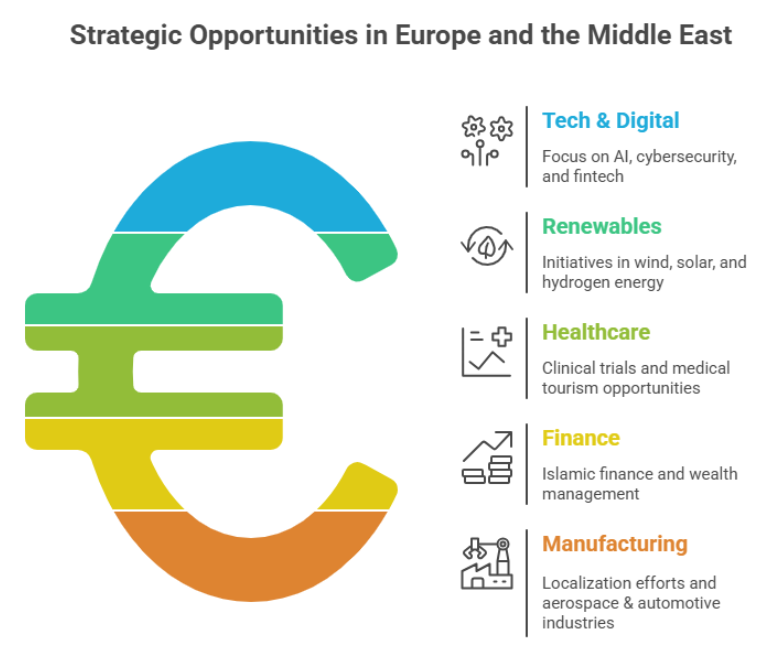
Technology and Digital Services
- Europe: Leads in AI research, enterprise software, and cybersecurity
- GCC: Driving government digital transformation, fintech innovation, and smart city development
- The Synergy: Develop cutting-edge solutions in Europe, deploy them in the GCC, then scale globally
Renewable Energy and Sustainability
- Europe: Advanced in wind power, energy efficiency, and circular economy models
- GCC: Investing heavily in solar, green hydrogen, and sustainable urban development
- The Synergy: Transfer technology, structure project finance, and trade carbon credits across regions
Healthcare and Life Sciences
- Europe: Strength in pharmaceuticals, medical devices, and clinical trial infrastructure
- GCC: Building healthcare infrastructure, medical tourism, and preventive care systems
- The Synergy: Accelerate market access, harmonize regulatory approaches, and share best practices
Financial Services
- Europe: Excellence in wealth management, insurance, and RegTech
- GCC: Innovation in Islamic finance, sovereign wealth management, and payment systems
- The Synergy: Drive product innovation, enable market expansion, and navigate regulatory arbitrage opportunities
Advanced Manufacturing
- Europe: World-class automotive, aerospace, and precision engineering
- GCC: Focus on localization, assembly operations, and regional distribution
- The Synergy: Transfer technology, integrate supply chains, and unlock new market access
Part VI: The 2025–2030 Outlook
Macro Trends Favoring Dual Presence
Several powerful forces are aligning to make dual presence not just attractive, but essential:
- Energy Transition: Both regions are pouring massive investment into renewables
- Digital Sovereignty: Europe’s push for technological autonomy and the GCC’s localization drives favor independent operators
- Demographic Dynamics: Europe’s aging population complements the GCC’s young, tech-savvy workforce
- Geopolitical Realignment: As US-China tensions persist, the Europe-GCC corridor emerges as a stable alternative
- Sustainability Imperatives: Net-zero commitments are driving unprecedented demand for green technology
The winners of the next decade won’t be choosing between the Middle East and Europe, they’ll be dominating both. Dual presence isn’t about hedging your bets; it’s about doubling your capabilities.
The opportunity is real and quantifiable:
- The UAE economy is projected to grow 5.1% in 2025
- Europe offers the world’s largest single market with unmatched regulatory influence
- The UAE aims to double its GDP to over $800 billion by 2030
We’re witnessing a historic moment where Middle Eastern ambition meets European excellence. Companies that move decisively now won’t just survive; they’ll shape the future of international business.
The choice is clear: stay regional and watch from the sidelines, or implement a dual-presence strategy and become a genuine global contender. The infrastructure is ready, the systems are in place, and the opportunities are there for the taking. But the firms that act in 2025 will be the ones that secure first-mover advantage.
The future belongs to bridge builders, not wall builders. And right now, the strongest bridge connects Europe’s innovation engine with the Middle East’s unstoppable ambition.